Why Smart Leaders Still Feel “Not Enough”
And How Early Programming Quietly Shapes Leadership Behavior
Most leaders don’t walk into the boardroom thinking:
“I’m not enough.”
“I don’t matter.”
“There isn’t enough.”
And yet…
These beliefs quietly shape how they lead every day.
Not because they are incapable.
But because they were formed long before leadership ever began.

The Invisible Origin of Leadership Behavior
Richard Barrett’s developmental model shows that our earliest years are organized around a small set of fundamental needs:
survival
safety
belonging
self-worth
Modern neuroscience reinforces this.
During the first years of life, the brain develops from the bottom up.
The emotional brain (limbic system) is highly active.
The prefrontal cortex—responsible for reasoning, perspective, and regulation—is still coming online.
Dr. Daniel Siegel’s work in interpersonal neurobiology shows that early experiences are encoded as implicit memory—patterns that shape perception and behavior outside of conscious awareness.
Attachment research (Bowlby, Ainsworth) further demonstrates that these early experiences form internal working models of:
Am I safe?
Am I valued?
Do I matter?
From these experiences, we form conclusions such as:
“There’s not enough.”
“I’m not safe unless I stay in control.”
“I’m not loved enough.”
“I don’t matter.”
“I’m not enough.”
These are not conscious beliefs.
They are adaptive interpretations wired into the nervous system.
How This Shows Up in Leadership
Fast forward decades.
The environment has changed.
But the internal programming often hasn’t.
A leader carrying an “I don’t matter” imprint may:
hesitate to speak up
over-explain or overcompensate
defer to louder voices
A leader shaped by “there’s not enough” may:
compete unnecessarily
struggle to delegate
operate from scarcity rather than strategy
A leader wired for “control equals safety” may:
micromanage
resist collaboration
feel overwhelmed by complexity
From the outside, these look like leadership style issues.
But internally, they are early survival strategies repeating in modern contexts.

The Conditioning Toward Familiar Patterns
Here’s where it becomes more subtle—and more powerful.
The brain is designed to prefer what is familiar.
Neuroscience describes this through predictive processing and Hebbian learning:
“Neurons that fire together wire together.”
Over time, repeated emotional states become the brain’s default.
Even when those states are stressful or limiting.
So leaders unconsciously recreate:
pressure
over-responsibility
self-doubt
control dynamics
Not because they want to suffer.
But because the nervous system recognizes the pattern.
It becomes the system’s default setting—automatic, familiar, and rarely questioned—
something the nervous system returns to, even when it no longer serves.
This is why mindset work alone often falls short.
Because these patterns are not just thoughts.
They are physiological patterns tied to safety, identity, and memory.
Why This Matters Now
In today’s environment—marked by complexity, speed, and constant change—leadership requires:
clarity under pressure
relational intelligence
creative thinking
adaptive decision-making
These capacities do not emerge from a nervous system in survival mode.
Polyvagal Theory (Dr. Stephen Porges) shows that when the system detects threat, perception narrows and behavior becomes reactive.
When the system experiences safety, the brain opens to:
connection
creativity
collaboration
strategic thinking
Leadership today is no longer just cognitive.
It is physiological, relational, and systemic.
From Programming to Leadership
The shift begins with a simple but powerful realization:
“I am not reacting to this moment alone.
I am reacting through a pattern formed long ago.”
That awareness creates space.
And in that space, leadership becomes possible.
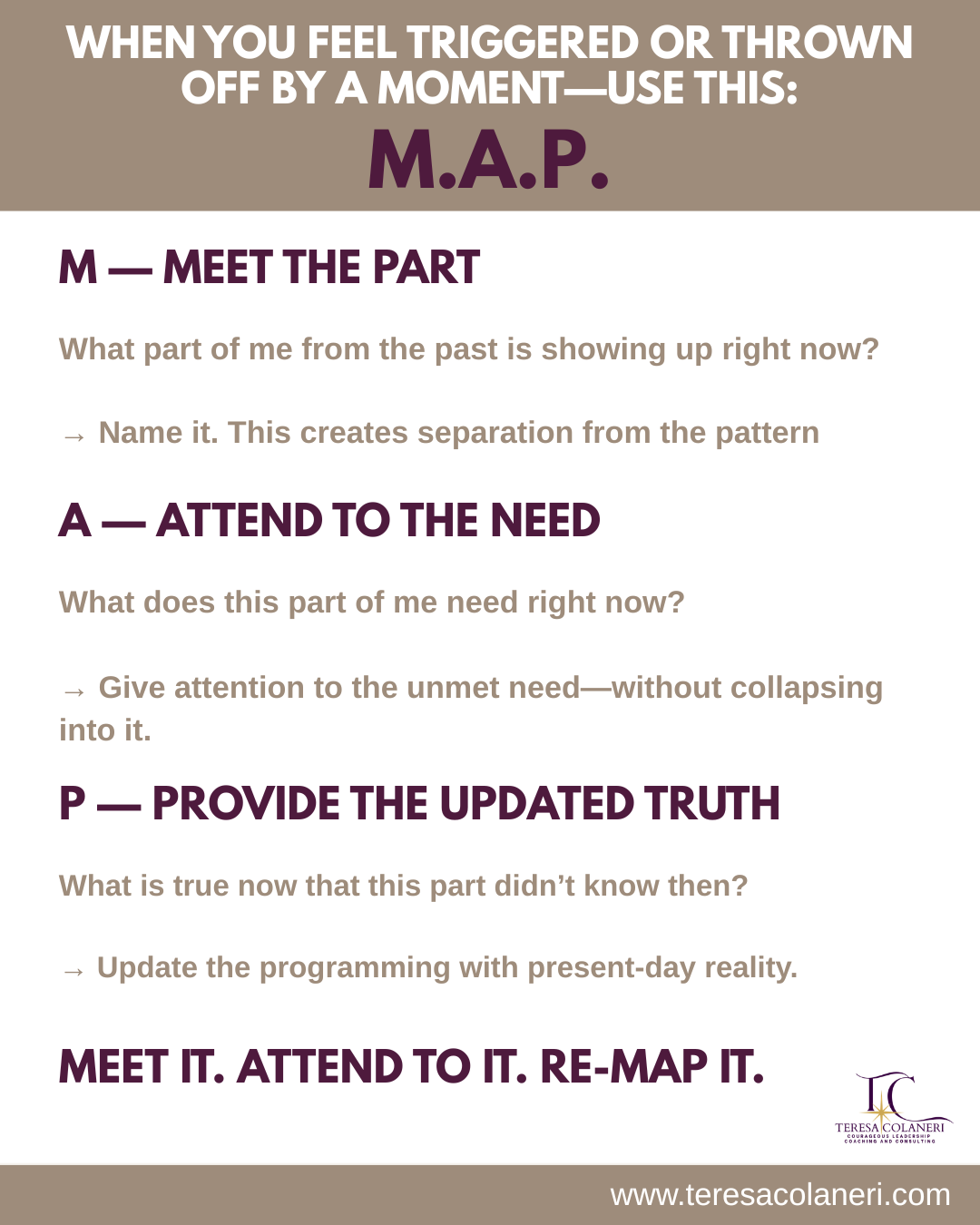
The MAP Reset (With Real Leadership Examples)
When you feel the sting of a reaction—when something lands and creates an internal shift—use this:
M — Meet the Part
“What part of me from the past is showing up right now?”
👉 You are identifying the origin of the reaction, not the surface emotion.
Examples:
- “This feels like the part of me that had to prove myself to be taken seriously.”
- “This is the part that learned my voice didn’t matter.”
- “This feels like the part that equates control with safety.”
- “This is the part that fears being wrong or exposed.”
In a real moment:
Your colleague interrupts you in a meeting.
Instead of reacting:
→ “This is the part of me that learned I have to fight to be heard.”
A — Attend to the Need
“What does this part of me need right now?”
👉 You are meeting the original unmet need, not the current situation.
Examples:
- “It needs reassurance that my voice does matter.”
- “It needs to feel safe without over-controlling.”
- “It needs acknowledgment—not pressure to prove.”
- “It needs permission to be seen without being perfect.”
In a real moment:
You receive critical feedback.
Instead of tightening:
→ “This part needs reassurance that I’m still valued—even while growing.”
P — Provide the Updated Truth
“What is true now that this part didn’t know then?”
👉 This is where you update the internal programming.
Examples:
- “I don’t have to fight to be heard—I can choose how and when I speak.”
- “I am respected here, even when I’m not perfect.”
- “I can lead without controlling everything.”
- “My value isn’t determined by this moment.”
In a real moment:
A decision doesn’t go your way.
Instead of shutting down:
→ “I am still impactful here. One outcome does not define my leadership.”
Full Application
Scenario:
A senior leader challenges your idea in front of others.
MAP in action:
M — Meet the Part
“This is the part of me that learned I have to prove myself to be credible.”
A — Attend to the Need
“This part needs to feel respected and secure without overperforming.”
P — Provide the Updated Truth
“I am credible here. I can stay present, listen, and respond thoughtfully.”
Closing Insight
The goal is not to remove the reaction.
The goal is to recognize it as information—and lead it, rather than become it.
This is not positive thinking.
It is updating the nervous system with present-day reality.
The Role of Inner Architecture
This is why developing your Inner Architecture of Leadership is essential.
Because leadership is not about eliminating parts of ourselves.
It is about integrating them.
When the ego leads, one voice dominates.
When the system becomes integrated, leadership changes.
Clarity emerges.
Coherence increases.
Decision-making aligns.
We move from:
reaction → response
fragmentation → integration
survival → leadership
From internal conflict…
to synchronization between head and heart.
Leadership is no longer about controlling behavior.
It becomes about directing awareness.

A Quiet Invitation
If this resonates, it may be because part of you recognizes these patterns—not as problems, but as invitations.
Invitations to evolve the internal architecture that shapes how you lead.
Because leadership is no longer just about mindset.
It is about coherence within the system.
And from that coherence…
a very different kind of leadership becomes available.
Thank you for reading. 🤍