



Thanksgiving Reflections: The Neuroscience of Gratitude
From Temporary Feelings to Lasting Fulfillment
As we enter this season of gratitude, I invite you to pause—not just to think about what you’re thankful for, but to feel it fully. Gratitude isn’t simply a nice idea; it’s a state of consciousness with measurable effects on the mind, body, heart and the evnironment you create around you.
Research shows that when we experience genuine gratitude, the brain lights up in the medial prefrontal cortex and anterior cingulate—regions associated with reward, empathy, and moral awareness. In other words, gratitude biologically connects us to the higher aspects of who we are.
As you may have epxerienced, practicing gratitude has been shown to:
- Improve mood and emotional resilience
- Enhance relationships and compassion
- Regulate the nervous system and support restful sleep
- Increase heart-rate variability—a sign of inner coherence and well-being
Why It’s Hard to Stay in Gratitude
If you’ve ever noticed how easy it is to lose your gratitude the moment stress hits, that’s not a personal flaw—it’s neuroscience.
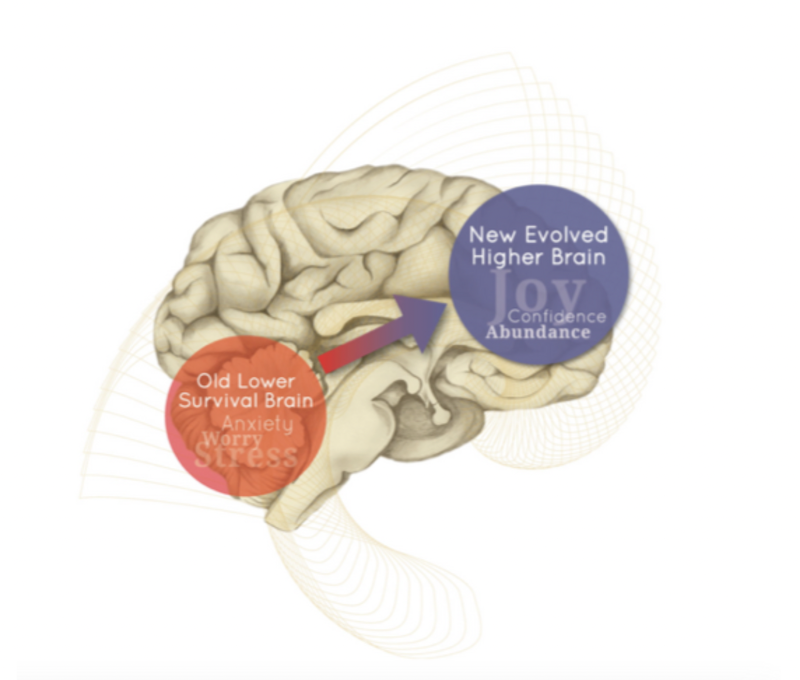
The lower brain (the primitive, survival-based part) evolved to scan for threats and keep us safe. It’s wired for fear, vigilance, and control. That’s useful if we’re escaping danger—but in everyday life, it keeps us in a subtle state of tension, even when everything is okay.
Pause Right Now
Notice your body—are your shoulders scrunched up? Is your breathing shallow? Is your jaw tight or your stomach slightly clenched?
This is how the lower brain whispers “stay ready.” It conditions the body for tension long after the moment has passed. Over time, that state becomes so familiar we mistake it for normal.
But every conscious breath, every moment of awareness, every genuine feeling of gratitude begins to retrain the body toward safety.
When we breathe deeper and soften our posture, we’re sending a powerful signal to the brain: “I’m safe now.”
That’s when the higher brain awakens—allowing openness, creativity, love, and gratitude to flow naturally.
And if we truly want transformation—beyond a few peaceful moments—then in addition to every conscious breath, we learn to activate the higher brain, the command center of change. When that part of the brain comes online, you become the conscious master of your life. You flourish.
Gratitude is no longer something you practice—it becomes the way you are.
Gratitude on the Map of Consciousness
In his groundbreaking work Power vs. Force, Dr. David R. Hawkins mapped human consciousness on a logarithmic scale from 1 to 1000. He discovered that 200—the level of Courage—is the tipping point between lower, survival-based energies (fear, anger, shame, guilt) and higher, life-enhancing energies (acceptance, love, joy, peace).
Remarkably, Hawkins found that nearly 85–90% of people operate below this threshold —driven by the lower brain’s instinct for safety and control. Only a small percentage live consistently above it, yet their impact is extraordinary.
Pause for a moment and consider your own life:
What’s your dominant baseline emotion?
What is the state of consciousness you spend the most time in?
Are you moving through the day from stress, pressure, vigilance, or self-doubt…
or from clarity, gratitude, compassion, and coherence?
Because consciousness expands exponentially, one individual consistently living from an elevated state of consciousness—marked by calm, gratitude, compassion, and coherence—can counterbalance the negativity of approximately 750,000 people living in lower states.
And “living from” is key.
It means this isn’t a temporary moment of feeling good.
It’s an authentic, embodied way of being—your nervous system, your emotional set point, and your consciousness operating from a higher level consistently, not occasionally.
And that is the power of gratitude—when it shifts from a fleeting emotion into the consciousness you live from.
Even if you don’t follow the model, you can feel its truth: gratitude lifts us beyond fear and lack into appreciation and abundance. It shifts our perception from what’s missing to what’s meaningful.
And while Hawkins’ map beautifully captures the inner journey of consciousness, it represents only part of the whole. True, lasting transformation happens when we integrate mind, body, relationships, and environment—the full spectrum of our human experience.
That’s where Higher Brain Living® comes in: it bridges science and spirit, awakening the higher centers of the brain that allow us to live these higher states—not as moments, but as a way of being.

The Power of the Written Word
Here’s something fascinating: writing about what you’re grateful for—pen to paper—activates more areas of the brain than typing.
When we write by hand, the kinesthetic movement engages sensory, motor, visual, and cognitive circuits all at once, creating deeper neural imprinting. That’s why a handwritten gratitude note or journal entry feels more embodied—it’s literally engraving gratitude into your nervous system.
Research Snapshot: Why Handwriting Activates More of the Brain
Recent high-density EEG research shows that handwriting leads to significantly greater brain connectivity than typing:
- In a 2024 study from the Norwegian University of Science and Technology, 36 students either typed or hand-wrote words.
Handwriting produced widespread synchronized activity across sensory, motor,
and memory-related regions, while typing produced far less activation.
(Van der Weel & Van der Meer, 2024 — Frontiers in Psychology)
- Scientific American summarized the findings this way:
Handwriting lights up networks “spanning visual regions, regions that receive
and process sensory information, and the motor cortex,” whereas typing activates
minimal pathways.
- Science News reported that handwriting boosts brain connectivity linked to learning, memory, and embodied processing.
In short:
Writing by hand doesn’t just express gratitude — it amplifies it neurologically.
It’s one of the simplest ways to engage your higher brain and with repeated commitment and repetition, make gratitude “stick” in your physiology.
That’s why a handwritten gratitude note or journal entry feels more embodied—it’s literally engraving gratitude into your nervous system.

From States to Traits: The Higher Brain Connection
Through Higher Brain activation, we can sustain these elevated emotions longer—turning fleeting states of gratitude into traits of peace, joy, and appreciation that are hard-wired into the brain.
When practiced consistently, gratitude literally rewires neural pathways, opening access to the prefrontal cortex—the seat of creativity, compassion, and higher perspective.
This is more than a mindset. It’s a lifestyle—a way of living from your highest consciousness, even amid challenge or change.
Your Thanksgiving Practice
And so before the holiday rush begins, take five quiet minutes to write—by hand—three specific things you’re grateful for today.
Feel them. Let the emotion expand in your body.
Then, in your mind’s eye, see yourself in this expanded state around the Thanksgiving table.
Notice the lightness in your chest, the warmth in your smile, the calm in your breath- and know everyone in the room is also benefiting.
See and feel the experience as real—because your subconscious mind does not distinguish between what is vividly imagined and what is physically experienced.
It accepts all as real.
By practicing gratitude this way—both felt and visualized—you’re training your brain and body to shift to this elevated state more easily and more often.
This is how transformation begins: repetition creates wiring.
So make your Thanksgiving practice a daily ritual, not just a holiday reflection.
Repeat it often, until gratitude becomes your natural frequency—a way of being, not just a seasonal moment.
And as you read these words, know this—
I am deeply grateful for you:
for your presence in this community,
for taking time to reflect,
and for all that you are becoming.
